
I grew up in interior Sindh, in a town called NayaChore, near Umerkot. Our family home had a single storey with a few rooms, a large verandah and an even larger open space attached to the house. As a child, I believed that all homes looked like this. I would imagine my future, living in a city, with a big verandah and garden. More than a decade later, I am now living in a two-bedroom apartment with my parents and one sibling. It feels naive to imagine shifting into a big bungalow in Karachi, given how expensive owning and maintaining a house has become. However, being an artist and actively working with creative organizations, I get to see the interiors of big bungalows very often.
You might be wondering what homes have to do with me being an artist? In Karachi, a majority of art is displayed within galleries and exhibition spaces inside residential buildings. What seems like any other house in Clifton or Defence could, in fact, be home to a carefully curated exhibition of artworks. Apart from enjoying looking at the artwork, ( since the house was initially built as a residence) I also imagine where the kitchen, lounge, and bedrooms were planned.
Going to a purpose-built gallery or museum is a very different experience. The most prominent exhibition in a planned gallery and museum I have been to was the recent curtain raiser of the Karachi Biennale 2027.
What is a Biennale
A biennale is a large scale exhibition or festival that takes place every two years. The word comes from Italian’biennale’ which literally means every two years. A biennale, at its core, is sort of like these exhibitions in spaces other than purpose-built galleries. However, a major difference is that a biennale is more accessible and happens all over the city at multiple venues. The Karachi Biennale ethos has been to engage the public, who do not know a lot about art. It is also to utilize public spaces as venues for exhibition to make the art more accessible. And finally, to keep the theme relevant to the current times.
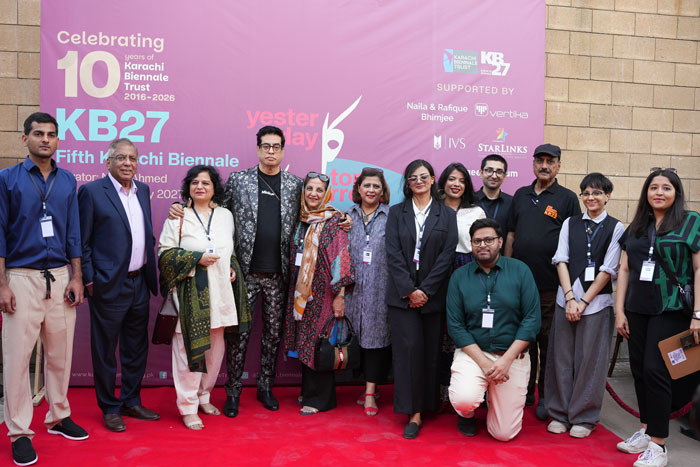
The Karachi Biennale Trust recently hosted a curtain raiser to introduce their vision for the next Karachi Biennale in 2027. This event was divided into two parts; a press conference where the KB team spoke to a select audience. This was followed by an open to public performance, new media and installation exhibition titled Aaj Aur Kal (Today and Tomorrow). The exhibition was curated by Amin Gulgee and Noor Ahmed. The entire curtain raiser event was held at the Amin Gulgee gallery and Gulgee Museum.
Museum Space
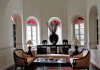
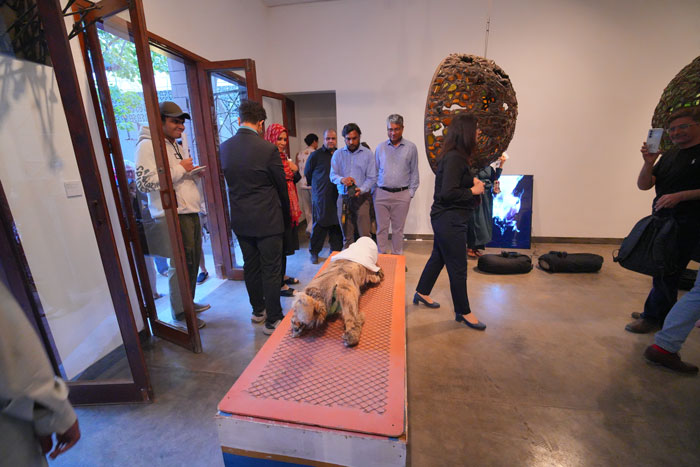
Amin Gulgee Gallery and Gulgee Museum are the kind of spaces that have been specifically designed for art exhibitions. On arriving I was welcomed by two volunteers who handed me a pamphlet with the names and details of all the participating artists. Since the press conference was still going on inside, I was guided to the courtyard inside the building. Two large rooms that are connected by three doors lead to the courtyard. I couldn’t help imagining this as a residential space. It seemed like a great spot for a kitchen and dining area looking into the courtyard; the three entryways would provide a lot of natural light to enter the kitchen.
Press Conference
The conference began with the Chairperson of the Karachi Biennale Trust, Atteqa Malik, introducing the Managing trustee, Shanaz Ramzi, to speak about KBT. Then Bushra Hussain reflected on the previous biennales as we approach the fifth edition of the Karachi Biennale in 2027. A video reflecting on all the previous Karachi Biennales was played and it was wonderful to see how much work has been done in the last 10 years.
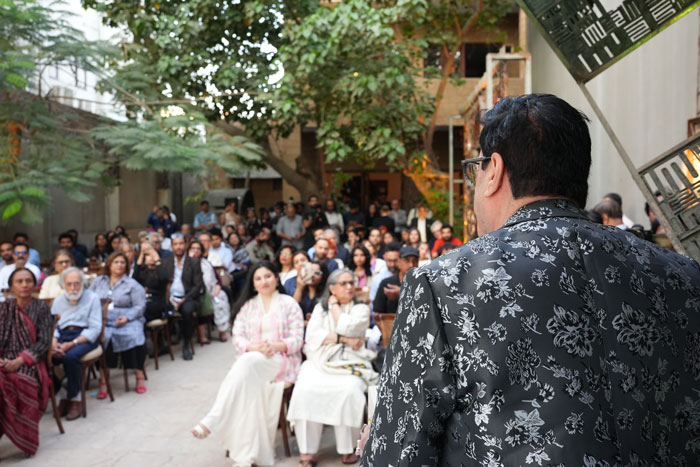
Then Malik introduced Noor Ahmed, who will be curating the Karachi Biennale taking place in 2027. Noor is a relatively young curator; however, her reputation preceeds her. One of her significant achievements is that she was a major part of the curatorial team for the Pakistani pavilion in Dubai Expo 2020. Her curatorial vision is deeply rooted in primarily looking at the future and how artists imagine what the future holds for us. Hence, the theme of the Karachi Biennale 2027 is Kal (Tomorrow/Yesterday). Kal is an Urdu word which means both tomorrow and yesterday. I find this theme to be especially relevant as our world dives deeper into violence and war, making us reflect on both the lasting effects of violence in the past and how unpredictable our future looks.
The press conference for the Karachi Biennale 2027 concluded with Amin Gulgee sharing a few words on the venue of the curtain raiser. The gallery and museum had previously been his parent’s (Ismail Gulgee and Zarine Gulgee’s) home. Amin spoke about his parent’s ideology; how they liked to live in the present. Amin said that he too follows his parents legacy of living in the now. He then opened the 77 minute Performance, New Media, and Installation Exhibition.
Flow of Space
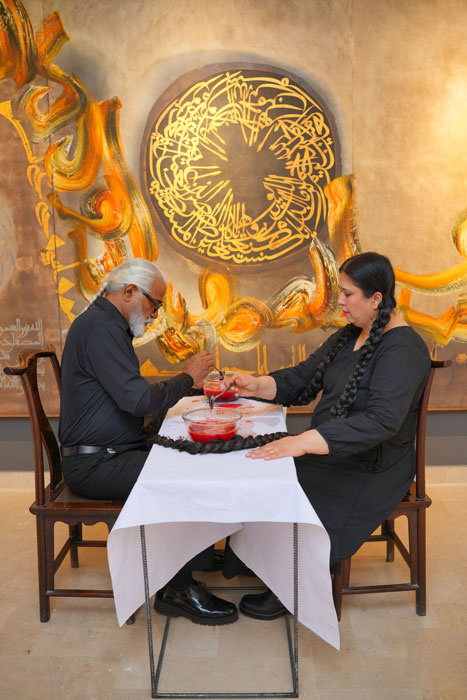
As I started walking from the courtyard back into the Amin Gulgee Gallery, I saw the space getting more and more crowded. By the time I walked inside, it was at maximum capacity. Even though the space was swarming with people, the crowd kept flowing. I am not sure if the general public knew how to view the work but people moved naturally from one exhibit to the other. I think I can credit both the construction of the space as well as how the works and performances were organized for this viewing experience.
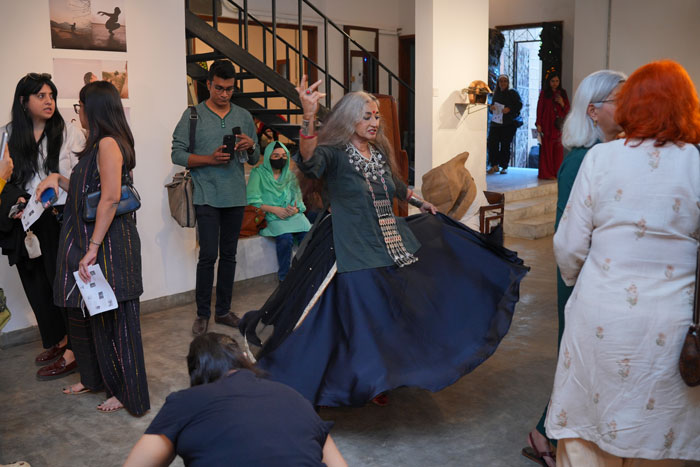
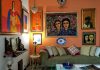
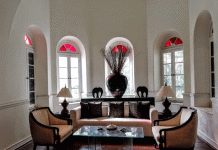
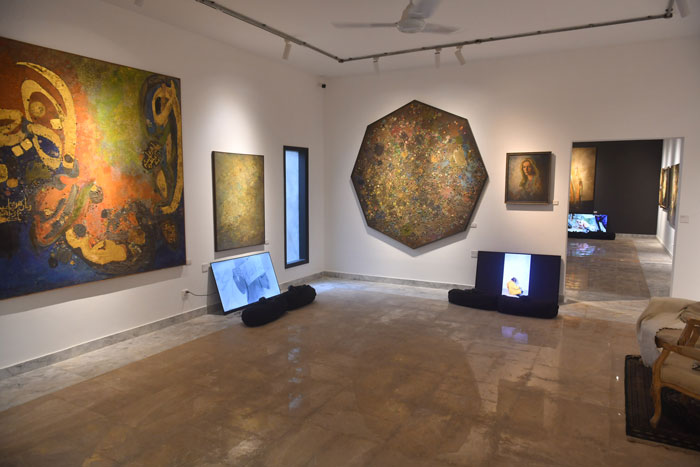
Amin Gulgee Gallery is attached to the Gulgee Museum. The gallery is a little reminiscent of a residential space and I could imagine a domestic setting. However, the moment you enter the Gulgee Museum, the space gives off a very different energy. I would call it very dynamic because it offers all kinds of spaces, from small rooms to large halls. Each space is carefully curated with Ismail Gulgee’s legacy. All the performances, new media works, and installations were placed without disturbing the existing works.
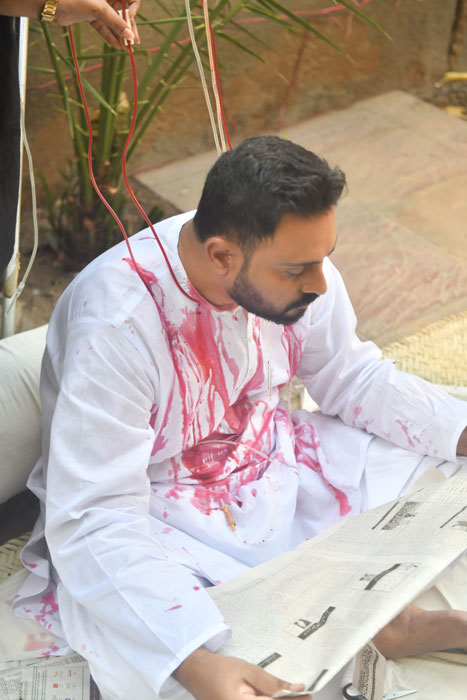
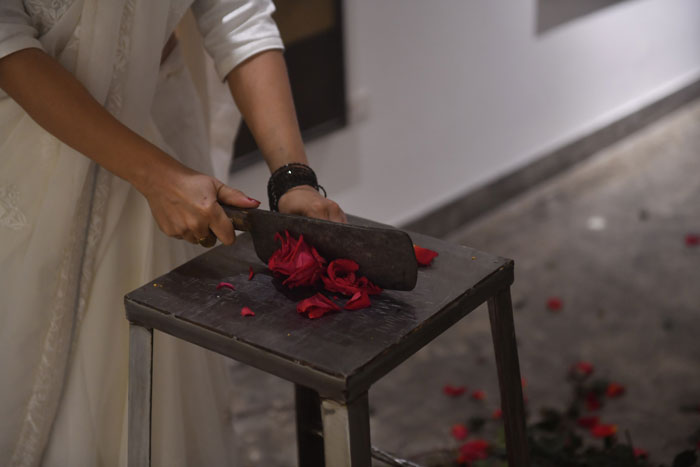
More than 70 artists from over 18 countries participated in this exhibition. To display these works in a space already replete with artwork is a commendable feat. From the moment one enters, a display is encountered at every step; even the bathroom of the gallery saw an artist performing. The collective energy of both the viewers and performers brought the space to life. I was able to view all the works with ease within 77 minutes; every little detail of the Curtain Raiser of KB27 seemed intentional.
I am really looking forward to Karachi Biennale 2027 and excited to see Noor Ahmed implement her curatorial vision.
The writer is Program Manager for the Karachi Biennale Trust and a visual artist, graduating from the Indus Valley School of Art and Architecture